
What Does a Leader Look Like? Debunking Myths About Women in Leadership Roles
Higher ed is asking more of its leaders than ever before. Executive leaders are attempting to steer their institutions through political turmoil, financial stress, decreased enrollments, attacks on their mission, and questions about the value of higher education itself. As challenges mount, the tenure of higher ed leaders has declined, amounting to what appears to be a leadership crisis.[1]
The leadership deficit facing higher ed doesn’t just impact executive leaders. The failure to develop good people-management skills throughout the higher ed workforce has the potential to perpetuate the high turnover rates experienced by many institutions in the last few years. Identifying and preparing leaders early on in their careers is key to building a more stable higher ed workforce that can withstand these mounting pressures and challenges.[2]
We need to do more to seek out and develop those who have been disproportionately left out of leadership considerations, most notably women.
Five Myths About Women in Leadership
Biases in the promotion process for both faculty and staff have led to gaps in the representation of women in leadership positions. These biases are often rooted in myths about what leaders should look like, where leaders come from and how they should behave.
There is a case to be made for taking a serious look at the women you’re not promoting.
We’ll examine five common myths about the promotion process and women in leadership:
- Promotions are based on straightforward, fair criteria.
- Promotions are an open playing field.
- Leaders must be charismatic.
- Women need to be more confident and commanding to get a promotion.
- Women don’t want leadership positions.
The purpose of this article is to lay bare some of these myths. We’ll also elevate the discussion from trying to change women to fit outmoded perceptions of what leaders look like to changing our promotion practices to fit current leadership characteristics that are demonstrably effective. In so doing, we can ensure more equitable promotion practices, close the gap for women in leadership positions, ensure a more robust and diverse pipeline for leadership positions, decrease the leadership deficit, and create more collaborative, adaptive and innovative workforce environments.
In short, there is a case to be made for taking a serious look at the women you’re not promoting.
Although this article focuses on women because of the clear gender leadership gap, the points made here can apply to other, often marginalized employees who may be overlooked for certain leadership positions, including:
- Employees of color
- Introverts
- Older employees
- Younger employees
- Obese employees
- LGBTQ+ employees
What a Higher Ed Leader Currently Looks Like
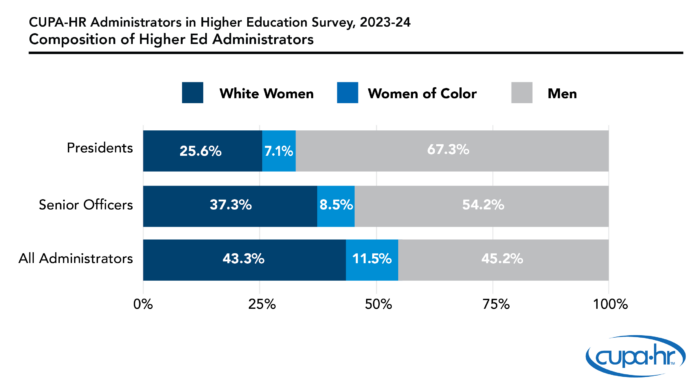
Women make up more than half (55%) of all higher ed administrators, as the chart below shows. But the proportion of women decreases as the level of seniority in administrative positions increases. At the higher rank of senior officers, including many chief positions, fewer than half (46%) are women. And women make up only one-third (33%) of higher ed presidents.[3] In other words, with increasing levels of seniority, you see a decrease in the number of women who fill those roles and an increase in the number of men.

We notice a similar pattern with tenure-track faculty. The chart below shows that women make up more than half of faculty at the assistant professor level — the point of hire. However, women’s representation decreases sharply with each successive increase in rank in tenure-track faculty — from assistant to associate to full professor.[4] Therefore, the efforts institutions have made to hire more women into faculty positions — particularly women of color — have been successful! Something happens, though, with the promotion process.
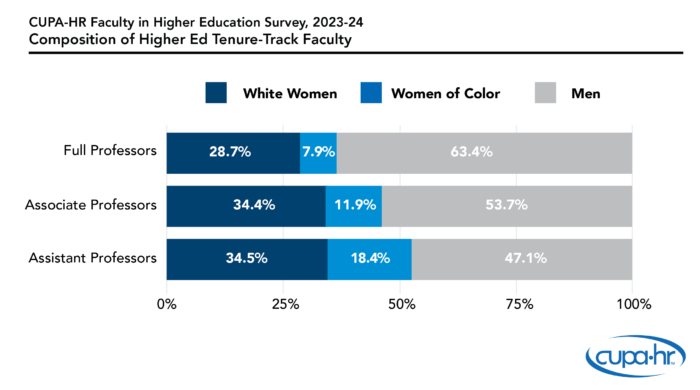
The failure to promote women to senior faculty positions has ramifications beyond the makeup of faculty. Senior faculty (those with full professor status) are the individuals tapped to chair departments, who are tapped to become deans, and who are tapped to become provosts, many of whom eventually become college presidents. It’s no wonder, then, that there is a shortage in the leadership pipeline of women who can fill these leadership positions.[5]
Why are female faculty and staff not being promoted at the same rate their male counterparts are? Let’s take a deeper dive into dispelling some of the myths surrounding leadership and the promotion process. We’ll also look at some solutions that might help move the needle in recognizing non-traditional leadership characteristics.
Myth 1: Promotions Are Based on Straightforward, Fair Criteria
Many positions have straightforward criteria for promotion on paper. Tenure-track faculty, for example, usually have detailed criteria for attaining promotion and tenure. These criteria may vary somewhat by institution, but they generally contain some weighted mix of expectations for publications, teaching evaluations, and service.
However, decisions on promotion and tenure are not based on whether candidates check all the boxes. Instead, they are often decided with an up-or-down vote by a committee, allowing for the introduction of bias.
Candidates who have equal qualifications on paper in terms of, say, number of publications, number of citations, and evaluations of teaching quality, can have vastly different outcomes in the up-or-down, all-or-nothing vote that determines whether a candidate is granted tenure. Thus, there is a veneer of equity and merit to this process that can be undermined by any number of subjective evaluations of a candidate’s fit for promotion.
When it comes time for a promotion, women receive lower ratings than their male peers for potential, despite the fact that women receive better performance ratings in many positions. The result is that women are 14% less likely to be promoted than are men.
These same biases can be injected into the promotion process for any employee. Although there may be straightforward criteria on paper for promotion, decisions regarding promotions are often decided by the up-or-down vote of a single supervisor. Decisions not to promote are generally not accompanied by detailed explanations as to why the promotion was not granted.
There are many jobs in which women achieve better outcomes than their male peers. This includes — but is not limited to — areas as diverse as sales,[6] medicine,[7] and coding.[8] However, when it comes time for a promotion, women receive lower ratings than their male peers for potential, despite the fact that women receive better performance ratings in many positions.[9] The result is that women are 14% less likely to be promoted than are men.[10] Ratings of potential outweigh ratings of performance. Herein lies the bias that can undermine any objective criteria used for promotion.
In addition, there are other unwritten rules that can hold employees back from promotions.[11] These unwritten rules go beyond throwback expectations for hobnobbing on the golf course or at the steak house. For example, some institutions may have flexible work policies, but a supervisor may have implicit expectations that employees work extra hours or forgo remote work for more face time in the office.
Myth 2: Promotions Are an Open Playing Field
Even in the unlikely scenario that an employee understands all the written and unwritten rules for promotion, the perception that promotions are an open playing field is misguided. When aspiring leaders are provided developmental feedback on performance reviews — feedback that is ultimately qualitative and subjective — we see some disparity in the feedback men and women are given.
Men get more actionable feedback than women. They are encouraged to set the vision, act politically, claim leadership positions, and display a confidence that is deemed to be inherent. Women, however, are encouraged to focus more on operational tasks, cope with the status quo, get along, and improve the confidence they are assumed to lack.[12]
The vague feedback women get has been shown to hold women back from leadership positions. Men get more feedback tied to specific outcomes. They also get more specific guidance as to what they need to do to level up. Women may be told that they are generally doing well, but they aren’t told what specific skills they’re doing well and what they need to improve. This vague feedback is tied to lower performance ratings.[13]
Poor feedback doesn’t just leave a dearth of employees in the pipeline for leadership. It also has an impact on retention. In fact, employees who receive low-quality feedback are 63% more likely to leave. And who is more likely to receive low-quality feedback? Women and employees of color.[14]
Myth 3: Leaders Must Be Charismatic
There’s a long-held perception that charisma is the defining characteristic of good leadership. Although charisma was an important evolutionary characteristic, conveying signals of intelligence and the ability to gain cooperation, that trait isn’t as important in a society where individuals experience multiple leaders in different contexts over a lifetime.[15]
Effective leadership is characterized more by the needs of the individuals being led and less by the ability of the leader to exert authority. Good leaders are enablers rather than managers.
Charismatic leadership produces followers of the leader because of the leader’s qualities. When the charismatic leader leaves or is not present, motivation among followers is then lacking. Traits that are important for today’s leaders to be effective have evolved to include authenticity, empathy, curiosity, adaptability, resilience, and empathy.[16] In other words, effective leadership is characterized more by the needs of the individuals being led and less by the ability of the leader to exert authority. Good leaders are enablers rather than managers.
Myth 4: Women Need to Be More Confident and Commanding to Get a Promotion
When it comes to being considered for leadership roles, women are often criticized for not being confident and commanding, qualities often associated with traditional male leaders. But when women mirror their male counterparts, they are often labeled as abrasive.
Women use what is often called “weak language” to counter the perception that they are too assertive. Phrases like “Correct me if I’m wrong, but…,” “Don’t you think that…,” and “sort of” are designed to be non-threatening ways of asking for or negotiating something. Data show that women are more likely to get what they ask for when using tentative language, as it’s perceived as less threatening.[17]
In fact, women know what they’re doing when they use weak language that’s less assertive. They must negotiate a balancing act that men do not. Women have had to learn more nuanced negotiation skills, as they must match the language and mirror the behavior they believe they need to use with the person they’re negotiating with. This type of skill is reflective of the sensitivity and empathy that makes them more effective in leadership positions. Rather than being penalized for this skill, they should be rewarded for it.
Myth 5: Women Don’t Want Leadership Positions
When I was co-presenting a webinar on a related topic just a few years ago, someone commented in the chat, “What evidence is there that women and people of color even want leadership positions?” That question made me realize that there remains an assumption that women don’t have enough drive to pursue positions of leadership or that they don’t desire leadership positions.
The data show otherwise. Post-pandemic, women are more ambitious than ever. About 80% of women currently express that they would like a promotion compared to 70% before the pandemic.[18]
There remains an assumption that women don’t have enough drive to pursue positions of leadership or that they don’t desire leadership positions. The data show otherwise. About 80% of women currently express that they would like a promotion compared to 70% before the pandemic.
However, men are the ones getting the promotions. Women represent only one-third of college presidents. Among tenure-track faculty, the only group that increases in proportion with promotions from assistant to associate to full professor are White men. Women — and particularly women of color — are well-represented at the point of hire, but fall off in proportion at each promotional opportunity.
We want women in leadership positions because decades of research shows that organizations thrive when they are.[19] The question isn’t whether women want leadership positions. The question is how we remove barriers to leadership and how we make leadership positions more attractive and available to women.
Possible Solutions
Examine your promotion processes and criteria. Determine where there may be bias in current promotion practices and implement methods of mitigating this bias. Ensure promotion criteria and processes are written down and followed. When promotion rests on an up-or-down decision, ensure that written explanations for these decisions are provided to the candidates, along with detailed feedback as to what the candidate can do to improve outcomes for future leadership considerations.
Train decision makers to recognize and mitigate bias. Having fair promotion criteria and processes written down can be undermined by supervisors who prefer to act on their gut when making promotion decisions. Training them to use objective metrics and recognize and mitigate biases that arise can help ensure that promotion decisions are more equitable.
Improve women’s advancement programs. Most leadership programs for women focus on teaching women skills that make them seem more like traditional male leaders, such as improving negotiating skills and boosting confidence and assertiveness. This conveys the message that women must assimilate and adopt traditional masculine archetypes of leadership to advance.[20] Instead, such programs should focus on empowering women to set new expectations of leadership and to enhance the collaborative and adaptive skills they already possess.
Reward and encourage employees who demonstrate the skills shown to characterize effective leadership in the modern workplace. Skills like empathy, adaptability and resilience should be elevated and recognized in written performance evaluations.
Incorporate promotion gaps into assessments of pay equity. Most pay equity studies examine pay only within a single position or rank. Stopping at this level of assessment means that the monetary losses over a lifetime of promotion denials (which are often much greater than the gaps in pay seen within a position or rank) go ignored. Promotion denials are effectively salary increase denials. These are quantitative assessments that should be factored into any pay equity study to gain an overall picture of pay equity within an institution.
Recognize unconventional leadership qualities. Reward and encourage employees who demonstrate the skills shown to characterize effective leadership in the modern workplace. Skills like empathy, adaptability and resilience should be elevated and recognized in written performance evaluations, establishing a record of these skills for future promotion considerations.
Encourage allyship and “brain trusts” to help employees navigate their careers and promotion processes. Allyships can help employees traditionally passed up for leadership. Allies “talk up” the skills and characteristics of potential leaders and help decode the unwritten rules of gaining specific leadership positions. Allies for women do not have to be women. Men can be powerful allies in using their in-group status to advocate for those who are historically disadvantaged in attaining leadership positions.[21]
Men can be powerful allies in using their in-group status to advocate for those who are historically disadvantaged in attaining leadership positions.
Recognize leadership potential in those who may not see it in themselves. Employees may still espouse theories of leadership that are outdated. They may not see themselves as leaders because they don’t possess what they believe to be necessary traits of charisma or assertiveness. Target them for allyships and advancement programs that change their own views of what a leader looks like.
About the author: Jacqueline Bichsel, Ph.D., is associate vice president of research at CUPA-HR. This article’s content is based on the presentation of Bichsel and Allison Vaillancourt, Ph.D., vice president and senior consultant, organizational effectiveness at Segal, presented at the 2024 CUPA-HR Spring Conference and the 2024 CUPA-HR Association Leadership Program.
Please use the following when citing this article: Bichsel, J. (2024). What Does a Leader Look Like? Debunking Myths About Women in Leadership Roles. Higher Ed HR Magazine.
[1] Anonymous. (2024). No Recess for Higher Education’s Leadership Crisis. Deloitte.
[2] Stephens, J. (2024). 4 Ways to Reduce Higher Ed’s Leadership Deficit. Inside Higher Ed.
[3] CUPA-HR. (2024). Administrators in Higher Education Survey [Data set].
[4] CUPA-HR. (2024). Faculty in Higher Education Survey [Data set].
[5] Schneider, J., & Bichsel, J. (2024). Representation and Pay Equity in Higher Education Faculty: A Review and Call to Action. CUPA-HR.
[6] Nekrasova, M., Becker, M., & Brooks Taplett, F. (2019). Closing the Gender Gap in Sales Leadership. BCG.
[7] Miyawaki, A., et al. (2024). Comparison of Hospital Mortality and Readmission Rates by Physician and Patient Sex. Annals of Internal Medicine. doi: 10.7326/M23-3163
[8] Terrell, J., et al. (2017). Gender Differences and Bias in Open Source: Pull Request Acceptance of Women Versus Men. PeerJ Computer Science. doi: 10.7717/peerj-cs.111
[9] Benson, A., Li, D., & Shue, K. (2022). “Potential” and the Gender Promotion Gap. MIT.
[10] Somers, M. (2022). Women Are Less Likely Than Men to Be Promoted. Here’s One Reason Why. MIT Sloan School of Management.
[11] Zimmermann, A. (2013). The Unwritten Rules That Could Hold You Back at Work if You Don’t Learn Them. The Guardian.
[12] Doldor, E., Wyatt, M., & Silvester, J. (2021). Men Get More Actional Feedback Than Women. Harvard Business Review.
[13] Correll, S. J., & Simard, C. (2016). Vague Feedback Is Holding Women Back. Harvard Business Review.
[14] Snyder, K. (2023). Language Bias in Performance Feedback. Textio.
[15] Bastardoz, N. (2021). Signaling Charisma. In book: The Routledge International Handbook of Charisma. Routledge International Handbooks.
[16] Knight, R. (2023). 8 Essential Qualities of Successful Leaders. Harvard Business Review.
[17] Grant, A. (2023). Women Know Exactly What They’re Doing When They Use “Weak Language.” The New York Times.
[18] Field, E., et al. (2023). Women in the Workplace 2023. McKinsey & Company.
[19] Novotney, A. (2024). Women Leaders Make Work Better. Here’s the Science Behind How To Promote Them. American Psychological Association.
[20] Tolan, C. M., Purushothaman, D., & Kaplowitz, L. S. (2024). How to Improve Women’s Advancement Programs. Harvard Business Review.
[21] Novotney, 2024.