


ICE Announces Extension and New Employee Guidance to Form I-9 Compliance Flexibility

 On May 26, the U.S. Immigration and Customs Enforcement (ICE) announced an extension of Form I-9 compliance flexibilities that was initially granted last year. Citing continued precautions due to COVID-19, the announcement declared that the flexibilities would be extended until August 31, 2021.
 May is Mental Health Month, and we’re homing in on three facets of higher education that impact mental health: campus culture, resources, and work flexibility. Here, in Part II of the three-part series, we’ll look at some of the barriers that prevent employees from utilizing resources, and how some approaches from the corporate world can offer inspiration for higher ed.
 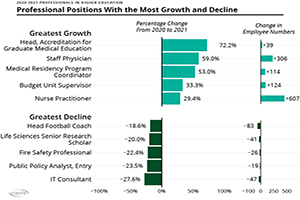 The higher ed professional workforce decreased slightly in size during the pandemic, though certain positions saw notable increases. According to CUPA-HR’s 2021 Professionals in Higher Education Annual Report released today, the number of full-time exempt higher ed employees decreased by 0.4 percent in the last year (2020-21), compared to an overall 4.4 percent increase in the prior year.
  CUPA-HR General Counsel Ira Shepard highlights recent rulings around a First Amendment case with wide implications for First Amendment lawsuits and governance issues at public higher education institutions, a Title IX claim brought by an independent contractor, an age discrimination lawsuit brought by a former department chair, and more.
  On May 13, 2021, DOL will issue a final rule delaying the effective date of the January 2021 final rule entitled “Strengthening Wage Protections for the Temporary and Permanent Employment of Certain Aliens in the United States” (Prevailing Wage Rule) from May 14, 2021, to November 14, 2022. The final rule also delays the transition date of July 1, 2021, when the actual new wage levels would begin, to January 1, 2023.
  May is Mental Health Month, and we’re homing in on three facets of higher education that impact mental health: campus culture, resources and work flexibility. This blog post is Part I of the three-part series. Here, we’ll discuss the importance of creating campus cultures that prioritize and promote the mental health of students, faculty and staff, and provide some examples and resources HR practitioners can adapt to their institutions.
  HR is in a prime position to call out cultural appropriation when seen on campus, but more importantly, to help employees understand the difference between appropriating and appreciating a culture and its people. Here are three ways HR can foster an atmosphere of appreciation by encouraging campus communities to respectfully observe and celebrate Cinco de Mayo and other cultural holidays throughout the year.
  On May 14, the House of Representatives voted (315-101) to pass H.R. 1065, the Pregnant Workers Fairness Act, which will require employers to make reasonable accommodations for qualified employees affected by pregnancy, childbirth or related medical conditions.
  On April 27, 2021, President Biden issued an Executive Order (EO) increasing the minimum wage federal contractors pay from $10.95 an hour to $15 an hour. According to a White House fact sheet, starting January 30, 2022, all agencies will need to include a $15 minimum wage in new contract solicitations, and by March 30, 2022, all agencies will need to implement it into new contracts. Furthermore, the higher minimum wage will need to be implemented into existing contracts when extended or renewed.